
10 Phrases That Scream “AI Wrote This”
In the modern world, one small typo can make you look like AI generated. Writers now get judged for sounding too smooth or perfect. A clean sentence can trigger suspicion fast. When your prose flows too well, people start scanning for bots. But chill, this guide got you. It breaks down 10 phrases that make writing sound AI made, even when it’s 100% human. Learn how to keep your tone real, natural and human online.
1. "In Today's Fast Paced World..."
Wasn’t this phrase the darling of high school essays? “In today’s fast-paced world…” seems pretty innocent. But the internet masses have spoken, and if they see this line, you have clearly outsourced your brain to a bot.
Forget that every world is fast paced for someone, somewhere. The phrase is thought of as an equivalent of saying, “Hey, let’s start with something everyone can agree on, this article is written by AI!”
If you want to sound like a robot, this is how you start. In fact, this phrase is so overused by AI that I would not be surprised if it runs for president soon.

Donald Trump and Kamala Harris in their First Presidential Debate (2024). AP Pic. CC BY 2.5 MY
2. "As We All Know..."
Sure, it is meant to sound like we are about to drop a universal truth bomb, but nope. Red flag! Apparently, humans no longer say things like this. It’s AI that does. It is like opening with, “I’m going to tell you something, but I assume you already know it,”. Even if it is real, it is a weird way to start any sentence. The only thing we all know at this point is that this phrase is shorthand for: “I didn’t want to do the research.”

3. "It Goes Without Saying..."
Does it really though? If it goes without saying, then why say it? Yet, somehow this phrase keeps popping up like an uninvited guest at the AI flagged party. It is the verbal equivalent of showing up in your pajamas, just a little too comfortable.
Bottom line? Well, if it really “goes without saying,” then let it. Just let it.
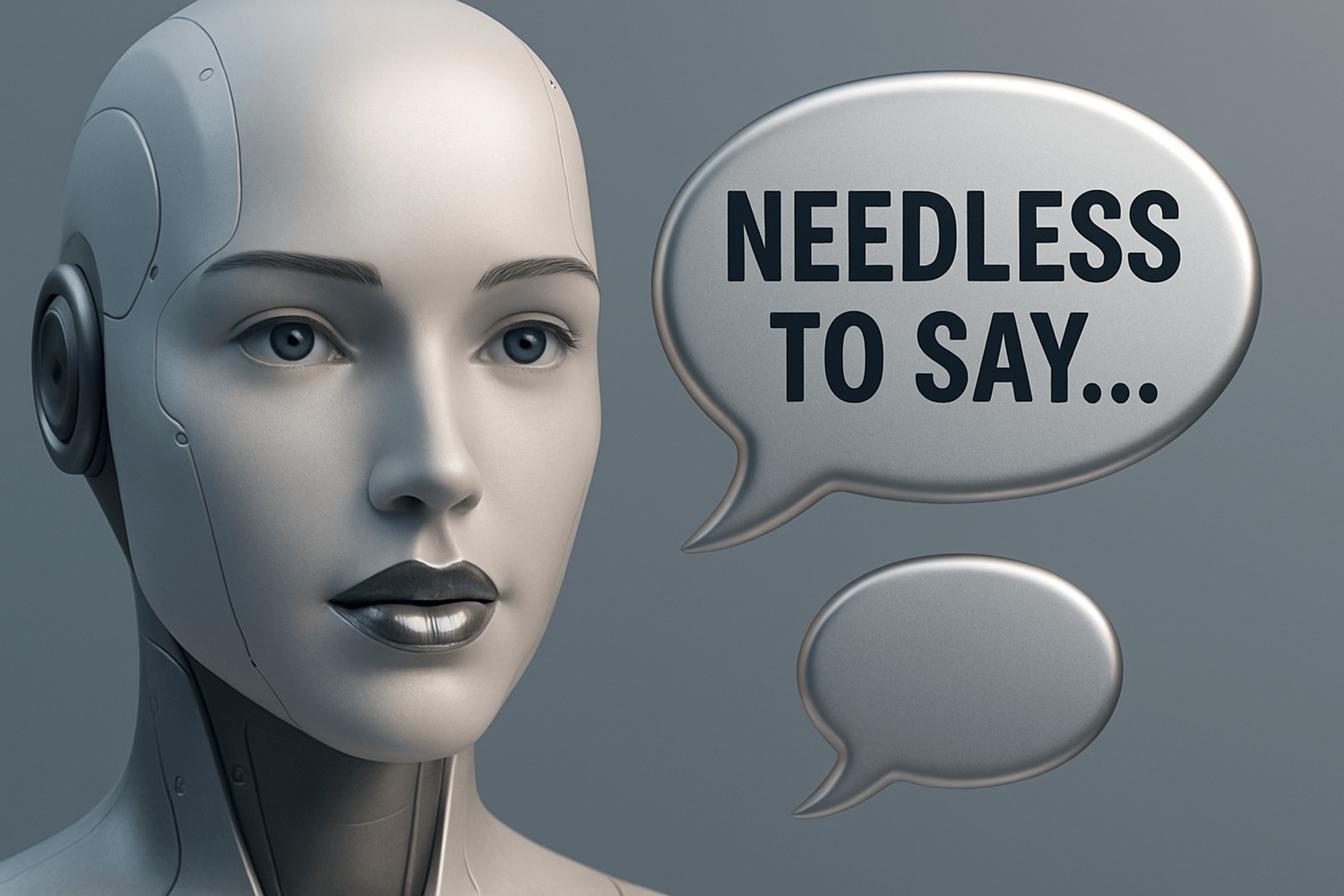
4. "Needless to Say..."
“Needless to say…” sounds clever, but it’s a total giveaway. The irony is real. People who use it almost always say exactly what they claim doesn’t need saying. The phrase feels polished yet hollow, a classic AI writing habit that tries to sound smart but ends up robotic. It’s the shiny packaging of nothing new. If you want your writing to feel human, skip it. Clarity and simplicity always beat needless words.
5. "Without Further Ado..."
Classic. Timeless. Ageless. And now, apparently, AI is trying to write a speech in Shakespearean English. If you are a human and you use this, congratulations! You have been mistaken for ChatGPT!

6. "Throughout History..."
I love this phrase. We all do, don’t we? But do you know who else loves it? AI does. This one is a favorite among AIs, because it instantly makes the writing sound important. “Throughout history” is like the opening line of a bad History Channel documentary. It tells the reader, “Look, I’m going to say something profound here even though I’m about to be incredibly vague.”

7. "Astonishingly..."
Hold on to your hats, my friend, because what you’re about to read is astonishing. Except, it’s usually not. ‘Astonishingly’, very much like it’s like its cousin “remarkably,” has been overused by AI to the point of meaninglessness. No one’s really astonished anymore. At this point, “astonishingly” is just a flare gun for AI-generated content. Be astonished at your own peril.

8. "In Conclusion..."
There’s something so final, so absolute about the phrase, ‘in conclusion’. Except now it’s more of a punchline than a grand finale. The truth is, that AI loves a good tidy wrap-up, and “In conclusion” has become its go-to.
Be honest with me on this one.
How many times did you see ChatGPT write anything huge without saying, ‘in conclusion’ at the end? Let me know in the comments.

9. "Furthermore..."
Ah yes, because saying “and” was simply too pedestrian. ‘Furthermore’ has been the victim of many AI-generated essays trying to sound smart. ‘Furthermore’ has seen the same fate as ‘moreover’ and ‘additionally,’. While these words once served a legitimate purpose, now they’re guilty in court. To the human ear, they sound just a bit too… robotic. So if you’re still using “furthermore,” maybe just stick with “and.” It’s not fancy, but at least no one will think you’re AI.

10. "It's Safe to Say..."
Irony alert! Is it really ‘safe to say?’ Because these days, nothing feels safe to say anymore. “It’s safe to say” is one of those phrases that’s been so overused by our dear old AI that it’s practically radioactive. If your writing starts with “It’s safe to say,” you might as well follow it up with, “…that I’m about to sound like a ChatGPT”.
Is it ‘safe to say’ that you should avoid this one? Absolutely.

Frequently Asked Questions (FAQ)
Because they are formulaic, overused and generic. AI leans on predictable openers and transitions and when writing gets too clean and predictable, the red flags pop.
Skip it. Trust your writing to wrap up naturally. If your concluding point is strong, you don’t need a neon sign announcing the end.
Yes. Those phrases often feel grandiose and vague. Replace them with concrete details, examples or human insight to stay grounded and authentic.
Drop the clichés. Write like you are talking to a friend, add personal details, inject subtle imperfection and share your own unique spin or voice.
Use them sparingly. They are fine in moderation, but many make writing sound stiff. Plain connectors like “and,” “but,” and “so” often flow more naturally.
Pause and ask: “What specifically am I trying to say?” Then rewrite with one vivid detail, personal anecdote, or fresh phrasing. Then it sounds like person, not a template.
Conclusion
In a world where good writing is suspicious and AI generated content lurks around every corner, we, as human writers, need to adapt. The lines between human and machine blur more every day. Phrases that once made us sound articulate now raise alarms. But here is the good news: knowing what to avoid is half the battle. When in doubt, just remember: if it sounds like something an AI might say, it is probably best to leave it behind.


The Money Hacker