
Allegations Against Roblox, Child Safety and the Attention Economy
Roblox looks playful on the surface. The world is bright here and the creativity is endless. Parents often see a digital playground. Children see freedom. But platforms are never neutral. Behind every screen sits a system designed to hold focus, extend time and convert engagement into value. When children become the core audience, the stakes change fast. What feels like play starts shaping habits, trust and spending behavior before anyone notices.
Roblox Under Legal Fire
Tennessee Attorney General Jonathan Skrmetti sued Roblox on December 18, 2025. The lawsuit claims the company pulled children into an online space it knew carried serious safety risks. At the same time, Roblox allegedly presented the platform to parents as safe. State officials argue this gap between promise and reality violates the Tennessee Consumer Protection Act (Tennessee Attorney General, December 18, 2025, Tennessee Files Lawsuit Against Roblox Over Child Safety Misrepresentations).
The case is not framed as isolated misuse by bad actors. It targets business behavior. Tennessee argues safety claims worked like marketing signals. Those signals built trust with families. Trust increased adoption. Growth followed. According to the state, that cycle continued even as risks were known internally.
At the center of the lawsuit is incentive design. Platforms built on repeat visits benefit from friction free interaction. Strong safeguards slow activity. Tennessee is asking whether Roblox chose growth over protection when children formed the core audience. That question now sits with the courts.

Experts Opinion
Researchers who tested Roblox using accounts registered to different ages said the risks were still easy to reach. They described a “troubling disconnect” between the child friendly image and what children can actually encounter. They also warned that new controls did not go far enough because children could still chat with strangers in many contexts and parents cannot realistically monitor millions of experiences at scale (The Guardian, April 14, 2025, Risks to children playing Roblox ‘deeply disturbing’, say researchers).
Child rights advocates push a harsher standard. They argue that safety must be built into the product itself, not added as advice after harm. Baroness Beeban Kidron said Roblox must be safe for children in order to trade and must include by design mechanisms that stop predators from gathering or searching for minors (5Rights, October 17, 2024, Gaming platform Roblox unsafe for children).

How Kids Get Affected
Roblox is designed to feel friendly and open. Bright visuals, playful avatars and user created worlds create an atmosphere that lowers suspicion. For children, the platform feels more like a shared playground than a public network.
Trust Forms Fast on Roblox
Roblox rewards cooperation and social interaction. Avatars wave. Chats feel informal. Games encourage teaming up with strangers. Young users often assume everyone follows the same rules. In Roblox’s mixed age environment, authority is hard to identify. That ambiguity lowers defenses. When trust forms early, risky interactions feel normal rather than alarming.
Play Turns into Pressure
Roblox blends play with visibility. Badges, wins, upgrades and social status act as signals. Being active matters. Logging out means missing events, rewards or friends. Participation starts to feel required. Over time, engagement shifts from curiosity to obligation. Belonging inside Roblox becomes something to maintain, not simply enjoy.
Habits Shape Behavior
Roblox encourages constant interaction through endless experiences and instant feedback. New games appear fast. Rewards arrive quickly. Repetition feels natural. Stepping away feels uncomfortable. These patterns settle quietly. Long before serious harm appears, attention habits harden. What begins as creative play on Roblox slowly becomes routine behavior shaped by the platform’s design.

Attention Economy for Children
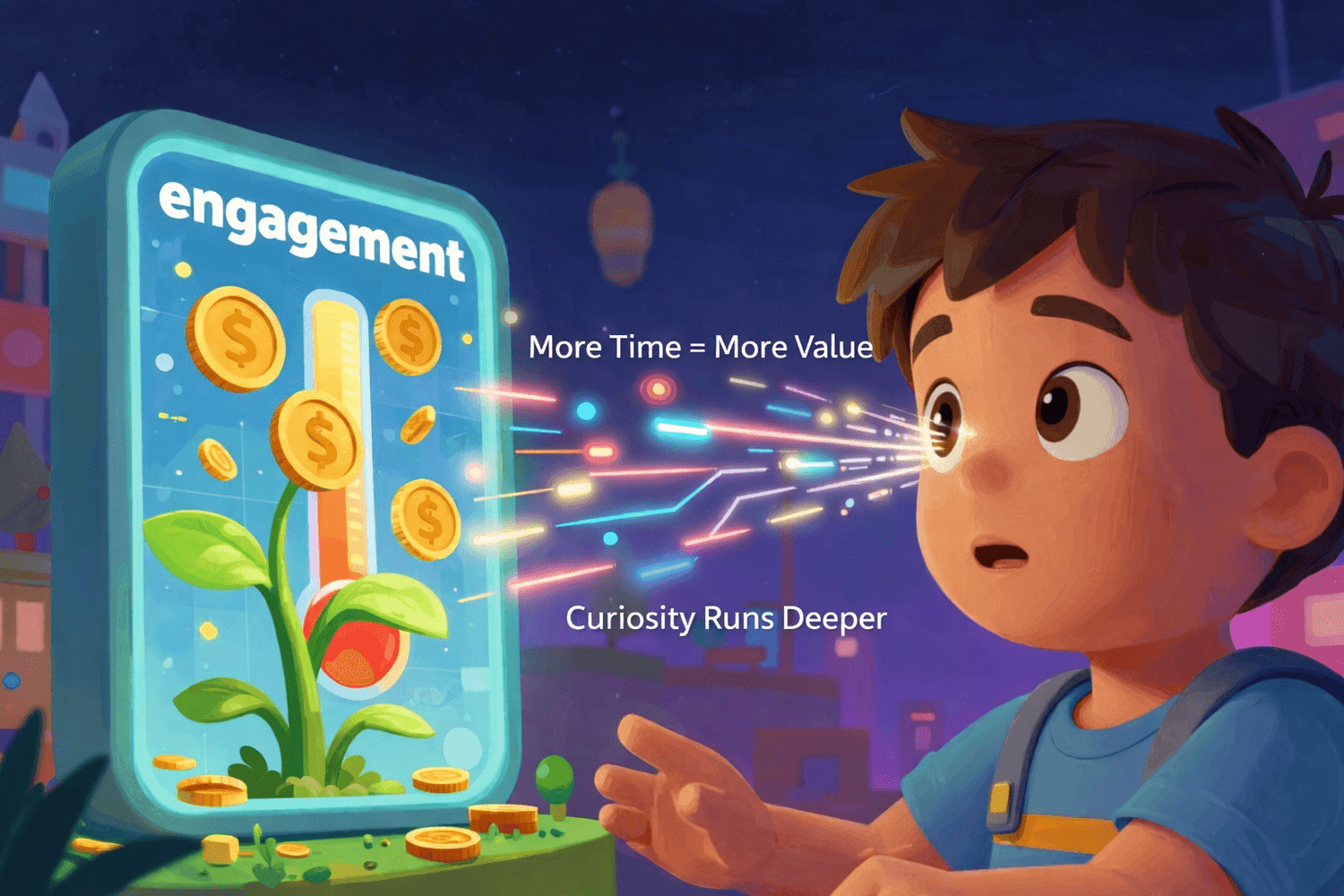
Attention fuels growth on platforms like Roblox. More time means more value. For children, this system hits harder. Curiosity runs deeper. Limits feel distant. Leaving feels costly. What starts as play slowly becomes attachment.
Money Hacker previously explained how engagement becomes currency across modern platforms (The Money Hacker, December 3, 2025, Making Money is a Game Know How to Play). When that same framework targets minors, ethical tension rises. Habit formation begins early. Disengagement feels unnatural. Control shifts away from families.
Roblox Money Engine
Roblox operates as an ecosystem, not just a game. Developers design experiences. Players return daily. Transactions stack quietly. The platform earns from participation loops.
In 2025, Roblox expanded programs that reward creators for driving repeat visits and sustained activity. Incentives favored re engagement rather than moderation friction (The Verge, June 24, 2025, Roblox wants to better reward creators for bringing players back).
Design incentives matter. What gets rewarded shapes behavior. Retention focused systems rarely slow themselves down.

Regulators Close In
Pressure on Roblox is no longer limited to one state. In November 2025, Texas filed its own lawsuit, accusing the company of hiding known safety risks from parents and failing to properly warn families about dangers children could face on the platform (Reuters, November 6, 2025, Texas sues gaming platform Roblox for allegedly concealing safety risks from parents).
This shift matters. Regulators are no longer framing harm as isolated misuse by bad actors. They are questioning platform design itself. Growth incentives, safety tradeoffs and business decisions are now under scrutiny. Roblox is becoming a test case for how governments judge child safety in the attention economy.

Creator Economy Lesson
Roblox highlights a core platform reality. Attention fuels expansion. Growth arrives fast. Responsibility often trails behind. Systems reward what spreads quickly, not what protects users. That imbalance shapes outcomes long before consequences surface.
Money Hacker has shown how reach driven formats often outperform deeper work (The Money Hacker, September 23, 2025, Which Pays More for Freelancers 10 Blogs or 100 Reels). Roblox applies that logic at massive scale. Creators gain visibility. Platforms secure revenue. Risk moves downward toward users. Trust erosion follows a predictable path. Protecting early costs less than repairing later.
Trust Beats Attention
Sustainable digital systems protect users before optimizing metrics. Clear boundaries slow abuse. Friction prevents damage. Long term value grows from confidence, not compulsion.
Money Hacker has highlighted income paths built on skill depth rather than algorithm pressure (The Money Hacker, October 10, 2025, Freelancing Goldmines Still Awaiting in 2025). The Roblox case proves why. Attention alone never builds stability.

To make sustainable digital system, you may join Skool community. This can be a perfect choice for you. $100K Money Hackers has been created for your benefit so that you get all sorts of support to make your surrounding sustainable in whatever situation you are in. Here you get all necessary guidelines and tools.
You can also collect PLR products like AI PLR Toolkit + Crazy Bonuses. Here you get 21 different prompts to create 21 types of PLR products using free AI tools like ChatGPT and Deepseek. It will definitely make your time valuable.
Frequently Asked Questions (FAQ)
It shows how platform design choices can trigger legal risk. Those risks can disrupt traffic, payouts and creator stability.
Fast engagement boosts reach but weakens confidence over time. Trust loss reduces loyalty and long term value.
Growth alone feels exciting but stays fragile. Skill based income holds stronger during platform shocks.
Yes, regulation can restrict features and monetization. Creator reach can shrink overnight.
Incentives, safety controls and transparency reveal future risk. Surface growth hides deeper problems.
Audience ownership and skill depth protect income. Distribution control lowers sudden exposure risk.
Conclusion
The allegations against Roblox reveal more than platform failures. They expose how attention driven models collide with child development. Safety cannot be a feature added later. It must be foundational. For parents, creators and builders, the lesson is direct. Platforms shape behavior. Business incentives decide outcomes. Understanding both is no longer optional.


The Money Hacker