
Why Elon Musk Thinks SpaceX Can Be a Trillion Dollar Company
A hundred trillion dollars sounds less like a business goal and more like a science fiction punchline. Yet Elon Musk talks about it with the calm tone of someone sketching a long term engineering roadmap. The idea is not that SpaceX is close to that number today. The idea is that space itself could become an economic domain as large as Earth’s current economy and SpaceX wants to be the infrastructure layer underneath it. To understand whether this ambition is fantasy or foresight, we need to break the claim into present reality, near term revenue and long term economic logic.
What Musk Actually Meant by $100 Trillion
The $100 trillion figure did not come from a staged announcement or investor presentation. It emerged in Musk’s direct responses when asked about SpaceX’s long term potential, where he said such a valuation is possible if humanity expands its economic activity into space (Yahoo Finance, December 23, 2025, Elon Musk Thinks SpaceX Could One Day Reach $100 Trillion Amid 2026 IPO Prep: ‘It Is Possible’). His framing matters because he treats the number as an outcome of scale, not as a target for market hype or near term valuation.
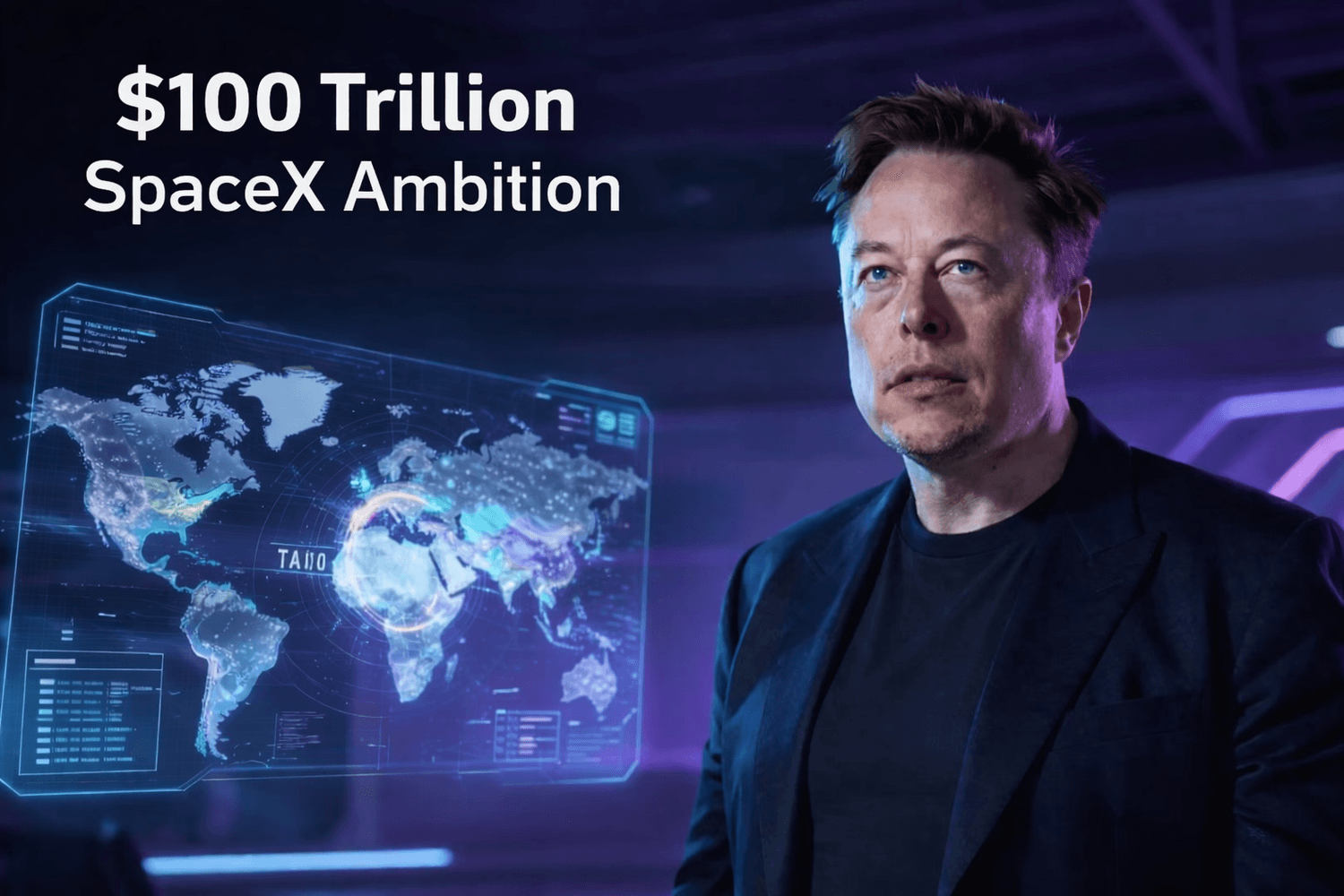
The key distinction is time horizon and economic scope. Musk is not talking about stock prices over the next decade or even the next market cycle. He is asking whether SpaceX could become central infrastructure for a future economy that includes orbital manufacturing, global satellite connectivity and off-Earth activity. In that context, the number reflects how large the economy itself could become, not what SpaceX is worth today.
Starlink Makes the Math Plausible
Rockets alone do not justify trillion dollar thinking. Recurring revenue does. Starlink transforms SpaceX from a launch contractor into a global infrastructure company with subscription income. Millions of users paying monthly fees creates predictable cash flow, which investors value far more than one off launch contracts.
This shift has already changed how markets think about SpaceX’s worth. Analysts increasingly point to Starlink growth and launch cadence as core valuation drivers rather than speculative Mars missions (Forbes, December 16, 2025, SpaceX Valuation Soars on Record Launches, Starlink Growth).

This mirrors how modern digital businesses scale. Tools matter, but networks matter more. The same logic explains why software platforms compound faster than standalone products, a pattern The Money Hacker often highlights when analyzing systems and tools for leverage free growth (The Money Hacker, December 21, 2025, Ultimate AI Tools That You Must Know).
Starship and the Cost Collapse
Starship is the hinge point between ambition and absurdity. Fully reusable heavy lift rockets would collapse the cost of sending mass to orbit. When marginal launch costs drop, space stops behaving like a rare scientific activity and starts behaving like logistics.
This is not theoretical. NASA selected SpaceX to build the lunar landing system for the Artemis program, awarding a multibillion dollar contract that signals institutional confidence in SpaceX’s approach to scale (NASA, April 16, 2021, As Artemis Moves Forward, NASA Picks SpaceX to Land Next Americans on Moon).
Infrastructure companies win by becoming cheaper, faster and more reliable than alternatives. In that sense, Starship aims to make access to space feel less like bespoke engineering and more like cloud hosting. The same principle explains why scalable platforms outperform legacy systems, a comparison often used in Money Hacker’s breakdowns of infrastructure decisions (The Money Hacker, December 27, 2025, Cloud Hosting vs Web Hosting for Starting a Blog).
From Private Markets to Trillion Dollar Valuations
Before SpaceX ever reaches public markets, private valuations already reveal how investors see its future. In late 2025, reports showed SpaceX setting a valuation close to $800 billion through secondary share sales, signaling that capital markets are pricing long term dominance rather than current earnings (Reuters, December 13, 2025, SpaceX sets $800 billion valuation, Bloomberg News reports). This kind of pricing usually appears when investors believe a company is building something foundational, not just profitable.
Valuations do not jump this way because revenue suddenly explodes. They move when markets believe a company controls assets that future industries will depend on. In SpaceX’s case, that belief centers on launch access, satellite networks and cost structures that could redefine how space is used commercially. These elements point toward infrastructure control rather than product sales.

Money Hacker has highlighted similar valuation psychology when comparing Elon Musk’s wealth trajectory with other tech leaders, showing how markets increasingly reward platform and infrastructure ownership over short term profitability (The Money Hacker, December 22, 2025, X or AI, Elon Musk or Larry Ellison). SpaceX fits this pattern clearly. Rockets are not the business, but the access is. Starlink is not just a service. It is distribution at planetary scale. Investors betting on SpaceX today are betting on who controls the pipes of tomorrow’s economy, long before that economy fully exists.
The Bottlenecks That Could Break the Story
Grand visions often collide with reality when execution becomes the limiting factor. SpaceX’s Starship program shows how difficult that transition can be. After an earlier test flight ended in an explosion, SpaceX launched another experimental Starship flight from Texas in late 2023, highlighting how progress in reusability still comes with major technical risk (Reuters, November 18, 2023, SpaceX Starship launched on test flight from Texas after last one blew up). Each test advances knowledge, but it also brings regulatory review, public scrutiny and pressure to prove reliability at scale.
Engineering is only part of the challenge. As Starlink expands and orbital traffic grows, governments are increasing oversight around safety, debris management and spectrum use. At the same time, competition from state backed space programs in China and Europe continues to accelerate. For SpaceX, the risk is not lack of ambition. The risk is whether execution, regulation and global competition can align quickly enough to sustain belief in a future built on routine, affordable access to space.
Takeaway for Builders and Investors
SpaceX shows that long term value comes from owning systems people depend on, not chasing moments of attention. Rockets matter, but access matters more. Starlink works because it turns space into a recurring service instead of a one time achievement, making reliability and scale more valuable than spectacle.
Elon Musk applies this same infrastructure first logic beyond space. In AI, his approach with Grok focuses on embedding the model inside his own ecosystem rather than selling it as a standalone product (The Money Hacker, October 3, 2025, Grok is Game Changer or Elon Musk Dream). This pattern explains why SpaceX is valued on future control rather than present profits. Builders who create dependency through recurring use grow faster than those who chase visibility. Investors watching for durable wealth should track systems that lower costs, lock in usage and quietly become unavoidable.
For gaining confidence, you need to learn and you should have the proper tool to move on. To equip yourself more, you can join $100K Money Hackers. Here you will get 35 AI tools for just $1/month. They will help you in your online business, dating life, fitness journey, to have fun and so much more! Be with the Skool Community and enjoy your time.
Frequently Asked Questions (FAQ)
The figure reflects future space economy size, not current valuation. Infrastructure control drives this thinking. Long horizon belief shapes capital interest.
Starlink adds recurring revenue through subscriptions. Predictable cash flow attracts long term capital. Network growth compounds worth quietly.
Reusable launches slash orbit costs. Lower prices unlock new commercial uses. Logistics replace rarity over time.
Engineering failures remain possible. Regulation pressure may increase. Global competition continues to rise.
Infrastructure locks usage through dependence. Switching costs stay high. Value compounds without constant promotion.
Recurring systems outperform one time wins. Distribution ownership builds stability. Scale rewards reliability over hype.
Conclusion
The $100 trillion number is not a prediction. It is a direction of travel. SpaceX is trying to move from being a company that launches things into space to a company that makes space economically usable. Whether it ever reaches that number matters less than whether it succeeds in becoming the backbone of a new market. History shows that when new economic frontiers open, the companies that build the roads, ports and networks shape wealth for generations. SpaceX is trying to be that company, only this time, the frontier is not on Earth.


The Money Hacker