
The Rise and Fall of Affiliate Marketing
Affiliate marketing changed how people earn online. It gave creators and freelancers freedom to build income from home. But the same model that made early internet success stories also created scandals, scams and regulation. Affiliate marketing, digital income and online business models all had to evolve fast. This story is about growth, collapse, rebirth and the lessons every digital entrepreneur should remember.
The Golden Era of Affiliate Marketing
In the early 1990s, affiliate marketing was revolutionary. It allowed individuals to earn commissions by recommending products they trusted. It was honest, simple and fair.

The idea began with pioneers like William Tobin, who used referral rewards for his online flower business in 1989. Soon, Amazon Associates turned it into a mainstream business model. The partnership worked: sellers gained buyers and affiliates gained income without needing to create products.
This was the age when affiliate marketing represented freedom. People learned to write reviews, share knowledge and earn from authenticity. For nearly two decades, it stayed one of the most democratic business models on the internet (Forbes, February 17, 2021, The Good, The Bad and the Value of Affiliate Marketing).
The Explosion and Distortion
By the 2010s, affiliate marketing had become a global phenomenon. Bloggers, YouTubers and course creators filled the market with promotions. The promise was fast money and easy systems. But growth without discipline brought problems.
Many programs began focusing on recruiting promoters instead of promoting genuine products. Some platforms blurred the line between affiliate marketing and pyramid style selling. They sold the dream of instant success, not the skill of long term business.
Affiliate marketing became less about value and more about hype. This period saw a sharp rise in “get-rich-quick” style promotions that eroded public trust.” (Sprout Social, July 8, 2021, What Is Affiliate Marketing? How Partnerships Drive Revenue)
Case Study
One case changed everything. My Online Business Education (MOBE) promised users they could learn to earn six figures online. Thousands joined and paid high fees for “training packages.” But in 2020, the Federal Trade Commission (FTC) shut it down (Federal Trade Commission, June 11, 2020, FTC Obtains Court Order Against MOBE for Deceptive Business Practices).
Investigations revealed that the business model relied heavily on recruiting new members rather than selling real products. The system rewarded promotion of the system itself. The FTC called it deceptive and secured a court order to close it.

This case created a shock wave. Legitimate marketers faced suspicion. Many new creators avoided affiliate programs altogether. The once trusted world of affiliate marketing now carried a warning label whether it is transparency or extinction.
The Aftershock and Industry Reset
After the fall of MOBE, the industry had to clean up. Major networks such as CJ Affiliate, ShareASale and Impact introduced strict rules. Affiliates were required to disclose paid relationships clearly.
Social media platforms started labeling sponsored links. Search engines prioritized content with transparency and authority. This reset saved affiliate marketing from collapse (TechRadar, April 10, 2025, Affiliate Marketing in 2025: Rise of Alternative Channels and the Video-First Revolution).
For creators, this new wave demanded honesty. They had to show receipts, proofs and real case studies. Affiliate marketing became a profession again. That is built on evidence, not excitement.

Rebuilding Trust with AI and Authenticity
The next chapter came with technology. Artificial intelligence began helping marketers analyze audiences, track conversions and personalize offers. The guesswork started to disappear.
Modern affiliates now rely on AI tools, transparent analytics and automation to improve every campaign. For instance, transparency led creators such as Pat Flynn, founder of Smart Passive Income, built credibility by publishing real affiliate income reports and case studies (Refersion, May 4, 2023, Top Affiliate Marketers That Profited from Their Online Presence). To learn what young creators are actually doing with AI to earn in 2025, check out Most Searched AI Hustles American Youth Use to Earn Fast.

At the same time, the affiliate industry is experiencing a new wave of reform powered by AI driven attribution models and data visibility. Analysts note that automation and measurable transparency are reshaping how affiliates earn trust and build sustainable revenue (AIjourn, July 4, 2025, Automation, Transparency and Trust: The Future of Affiliate Marketing in an AI-First World).
Today, the most successful affiliate creators teach first and sell second. They share honest reviews, useful tutorials and real experiences instead of empty slogans. The era of hype has ended, trust is now the strongest currency in affiliate marketing. To see which AI powered hustles young creators are using to earn fast in 2025, check out Generative AI Modeling is Freelancers’ Secret Power 2025.

Action Checklist for Modern Affiliates
Step 1 : Choose Products You Truly Believe In
Pick offers that solve real problems. Every sale must represent value.
Step 2: Build Trust Before Selling
Publish useful tutorials, case studies or reviews. Let authenticity lead the pitch (Forbes, April 1, 2024, Why Faceless Creators Are Taking Over Your Social Media).
Step 3: Disclose Everything Clearly
Tell audiences when a link earns you commission. Transparency builds loyalty.

Step 4: Use AI for Smarter Insights
Leverage tools for data tracking, SEO optimization and audience segmentation.
Step 5: Keep Learning and Updating
Affiliate marketing evolves fast. Regularly audit strategies, check trends and stay compliant with FTC guidelines.
Following these steps keeps any affiliate brand sustainable in 2025 and beyond. Learn how affiliate marketing nearly died and how to win now in “Why Affiliate Marketing Nearly Died and How to Win Now”.
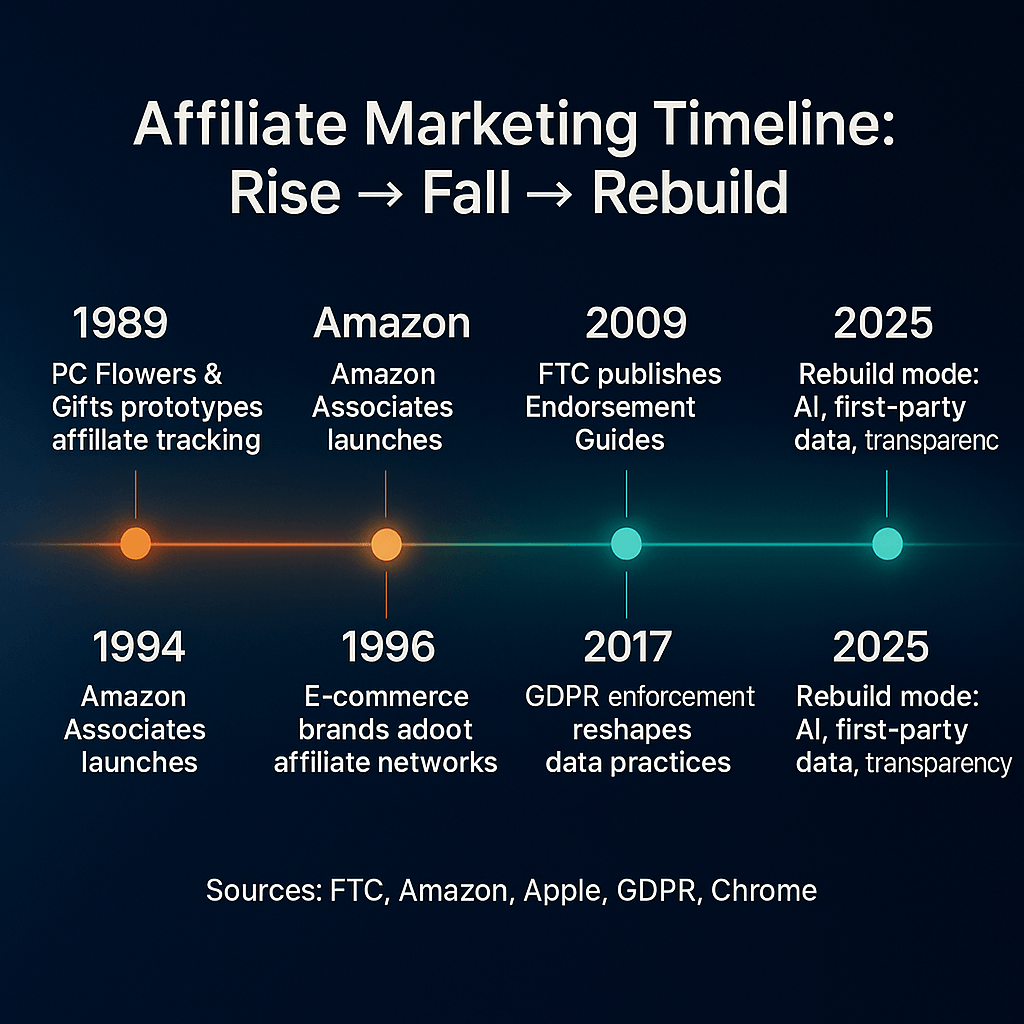
Affiliate Marketing Timeline: Rise → Fall → Rebuild
The journey of Affiliate marketing spans over three decades, from a creative spark in the 1980s to a global digital powerhouse reshaped by AI and transparency. This visual timeline highlights the turning points that defined its evolution.
Frequently Asked Questions (FAQ)
Hype and recruitment first programs hurt people. Sell real value, disclose links and keep proof of results to rebuild trust.
Test products you use. Check refund rates, payout terms and support quality. Start with one proven offer before you scale.
Tighten your content to one problem and one solution. Add a clear CTA, an email capture and a simple comparison table.
Use AI for keyword research, audience segments and A/B tests. Keep your voice human. Share results and screenshots.
Track CTR, add-to-cart rate, conversion rate and refund rate. Watch average order value and email signup rate weekly.
Disclose every affiliate link. Follow the FTC guide. Use honest reviews, real demos and clear benefits. Trust brings repeat buyers.
Conclusion
Affiliate marketing rose because it was built on trust. It fell because people chased shortcuts. Now it rises again through clarity, technology and truth. The story of it mirrors the internet itself. It is open and chaotic, but full of second chances. The lesson is simple here. Those who sell truth will always outlast those who sell dreams.


The Money Hacker