
What Saying Goodbye to 2025 Means for Your Money in 2026
January arrived quietly, but financial pressure stayed loud. 2025 closed many doors, yet habits moved forward without rest. Some people waited for relief. Others rebuilt systems before the next shock. Money now favors action backed by structure. This article explains how leaving 2025 reshapes finances, income paths, risk awareness and preparation inside 2026.
The Carryover Nobody Escaped
2025 offered no breathing room. Living expenses stayed heavy across routines. Spending habits rolled forward without a pause. Families cut back because survival demanded discipline. Months of strain rewired everyday judgment. Early 2026 choices still carry those instincts. Financial memory moves slower than news cycles.
Outlooks confirm tension ahead. Expansion appears possible yet clarity feels absent. Smart planning beats hopeful waiting during uncertain phases (Morgan Stanley, November 19, 2025, 2026 Economic Outlook: Moderate Growth With a Range of Possibilities). This carryover explains why freelancing keeps rising as a stability play rather than a side trend, especially among young Americans seeking control over earnings (The Money Hacker, September 12, 2025, Freelancing Becoming Core Hope for Youths in USA).

Interest Rates Move Unevenly
Rate cuts sound comforting. Reality moves slower. Credit cards adjust early. Savings yields react quickly. Fixed loans resist longer. This mismatch creates quiet winners and hidden traps. Cash holders feel short relief. Revolving balances absorb delayed stress. Timing shapes outcomes more than headlines.
Rate shifts reward awareness, not hope. Knowing where interest rises first protects decisions. Understanding lag prevents false optimism. Action paired with clarity turns cycles useful (Investopedia, November 12, 2025, What’s the Outlook for Interest Rates in 2026?). Central bank guidance also reflects gradual easing with careful positioning ahead (JMCO, December 24, 2025, Federal Reserve Cuts Main Rate to 3.5% to 3.75% Range, Signals Cautious 2026 Outlook).

Global Growth Feels Personal Pressure
Economic headlines look calm, but personal finances still feel unstable. Growth at the top does not translate evenly at the ground level.
Why Macro Growth Feels Distant
Forecasts point toward expansion. Balance appears on paper. Individual stability remains uncertain. Some industries accelerate fast. Others stall without warning. Income now depends on positioning, not averages. Demand alignment matters more than optimism (Goldman Sachs, December 19, 2025, The Global Economy Is Forecast to Post ‘Sturdy’ Growth of 2.8% in 2026).
Adaptability Becomes Survival
Large institutions already recognize this divide. Flexibility supports income strength. Rigidity weakens it. Stability favors those who adjust skills, roles and timing instead of relying on broad growth narratives.
The Creator Economy Example
This gap shows clearly inside creator work. Attention concentrates while rewards narrow. Visibility increases, yet payouts fragment. Platforms raise pressure instead of security. Reach alone no longer protects income.
Strategy Over Volume
Many creators chase exposure without control. That approach fades fast. Strategy replaces volume as protection. Growth lifts systems, not individuals. Monetization paths must be deliberate to survive attention economics (The Money Hacker, December 15, 2025, Attention Economy Pushes Creators ).

Skills Decide Income Stability
Employment security now depends on relevance. Job titles carry less weight than capability. AI reshaped expectations across industries. Learning speed became currency. Static skills lost pricing power as demand shifted faster than roles. Income now follows those who adapt before disruption arrives (World Economic Forum, January 7, 2025, The Future of Jobs Report 2025).
This shift explains why translating skills into visible output matters more than credentials. People who turn trends into usable income gain resilience. Those who only observe fall behind. Practical application builds stability faster than theory, which is why converting viral momentum into real income paths is becoming a core survival skill (The Money Hacker, December 26, 2025, Viral Trends into Real Income).

The 2026 Money Stacks
Stability in 2026 comes from structure, not comfort. Income pressure, uneven rates and platform shifts favor people who build systems that react fast. Calm financial decisions usually come from setups designed for disruption.
This stack now centers on skill driven income backed by intelligent systems. Liquidity protects focus during income gaps. Debt discipline stops interest drag. AI tools raise earning power by improving speed, pricing and output consistency. Freelancers using machine learning already convert effort into clearer returns by aligning skills with demand early (The Money Hacker, September 30, 2025, AI and Machine Learning to Maximize Freelancer Income). These systems reduce guesswork and protect momentum.

Generative AI pushes this further by turning skills into repeatable income assets instead of one time labor. Modeling workflows and services allows scaling without adding hours. This is becoming a core income advantage, not an optional upgrade (The Money Hacker, December 05, 2025, Generative AI Modeling Is Freelancers Secret Power 2025).
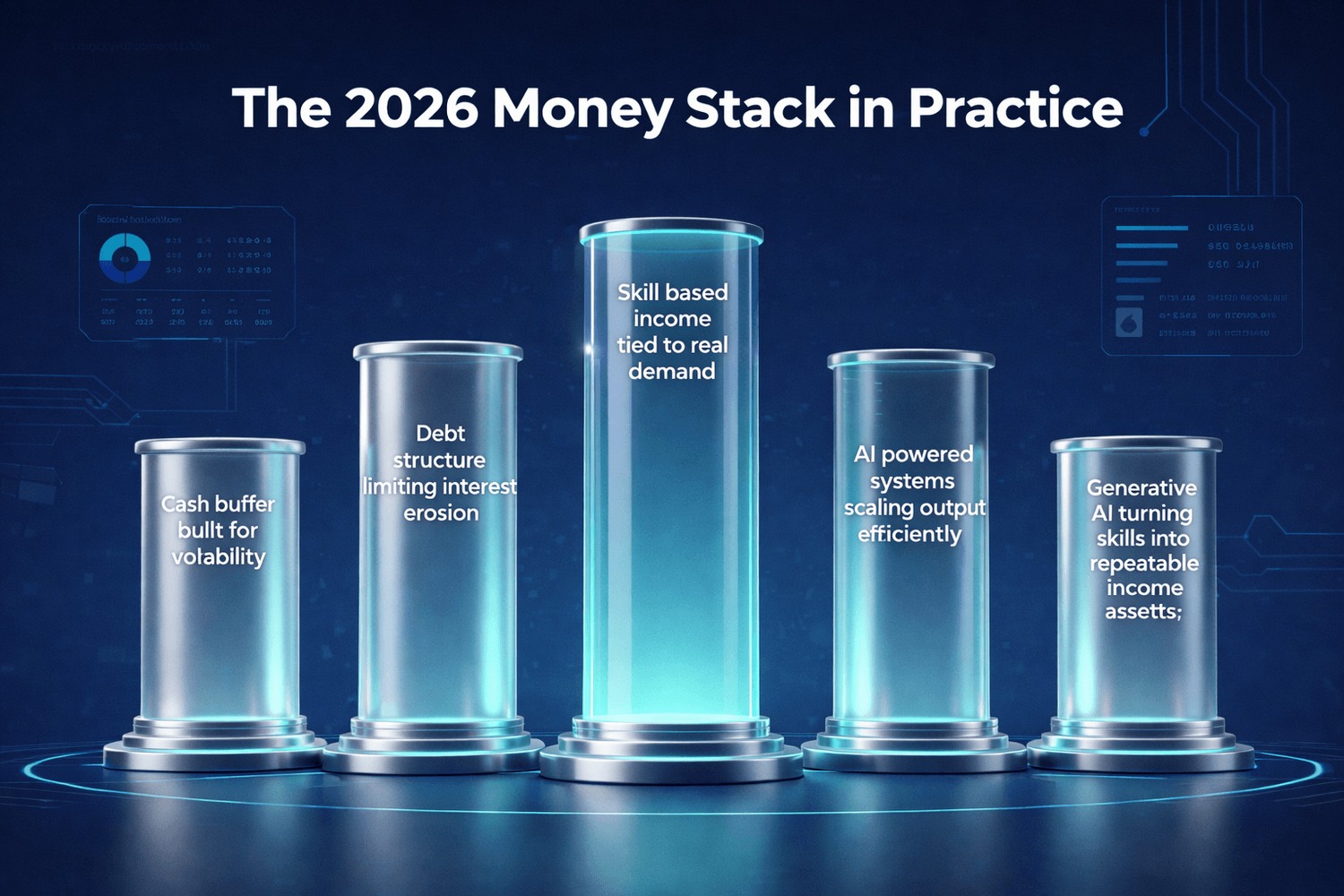
The 2026 Money Stack in Practice
• Cash buffer built for volatility
• Debt structure limiting interest erosion
• Skill based income tied to real demand
• AI powered systems scaling output efficiently
Freelance Gravity Gets Stronger
Uncertainty pushes people toward control. Independent work offers control when systems are clear. Flexible income models attract skilled professionals seeking stability through ownership. Proof driven output now outweighs credentials. Distribution and visibility matter as much as talent. Workforce behavior already reflects this shift as freelancing moves from backup option to primary income planning (The Money Hacker, September 19, 2025, Why Ireland Youths Choosing Freelancing Over 9 to 5). Younger earners increasingly value flexibility, pricing power and speed over long term promises.
External forces accelerate this pull further. Policy moves and supply chain shifts open narrow but real opportunities across specialized markets (The Money Hacker, December 31, 2025, Trump Approves Samsung China Materials). Independent earners adapt faster to these ripples. They reposition skills quickly, capture emerging demand early and avoid slow institutional response cycles.
A January Reset That Works
Momentum beats motivation because systems survive moods. A real reset begins with control, not planning noise. January rewards decisive moves made early, before comfort returns.
• Cut unnecessary expense leaks and lock visibility
• Strengthen cash protection against surprise pressure
• Upgrade one income skill tied to demand
• Publish output that proves value in public
Execution compounds faster than intention. Action reshapes confidence. Those who move now enter 2026 ahead of hesitation.

To make your 206 meaningful and to gain financial freedom, you can join $100K Money Hackers. Here you will get 35 AI tools for just $1/month. They will help you in your online business, dating life, fitness journey, to have fun and so much more! Be with the Skool Community and enjoy your time.
If you want to earn money quickly by any means in online domain, access The Quick $750 Hack. It is completely free for you. Remember, your financial freedom is our commitment.
For mastering copywriting and earn maximum money online, you can use tool like 620 ChatGPT Prompts for Copywriting. Using this bot, you will be able to create sales pages, emails & ads in minutes.
Frequently Asked Questions (FAQ)
2025 reshaped spending discipline and risk awareness. Freelancers entering 2026 benefit by building structured income systems early. Control now comes from skills, visibility and faster execution.
Adaptable skills tied to real demand protect earnings. AI literacy, problem solving and delivery speed now decide pricing power. Static abilities lose value faster than before.
Generative AI modeling turns expertise into repeatable workflows. This reduces time dependency and increases output consistency. Scalable systems replace one time labor.
Economic pressure favors control over promises. Freelancing allows faster adjustment to market shifts. Ownership of skills and distribution strengthens income resilience.
A strong cash buffer protects focus during income gaps. Controlled debt limits interest erosion. Skill based income paired with AI systems keeps momentum steady.
Start with expense visibility and cash protection. Upgrade one demand aligned skill. Publish proof driven output to attract income faster.
Conclusion
Closure around 2025 signals transition rather than relief. Habits carry weight forward. Markets reward readiness over hope. Structure steadies nerves during volatility. Calm systems unlock choice amid uncertainty. 2026 favors builders acting early through visible output. Momentum grows quietly. Confidence follows motion. Future money belongs to prepared minds. Intentional preparation compounds advantage tomorrow.


The Money Hacker