
Survival Thinking Freelancers Can Learn from Forefathers' Day
Freelancing is marketed as freedom but experienced as uncertainty. Income shifts without warning. Clients pause work suddenly. Platforms rewrite rules quietly. This environment does not reward optimism alone. It rewards survival thinking. Forefathers’ Day offers a sharp mental framework because it represents endurance under unknown conditions. Early settlers entered unfamiliar land without safety nets. Freelancers navigate a modern frontier shaped by markets and algorithms. The context changed. The survival logic stayed intact.
Forefathers' Day as a Survival Lane
Forefathers’ Day marks the arrival of the Pilgrims at Plymouth in 1620 and the formation of a settlement defined by scarcity, uncertainty and constant risk. The early community faced food shortages, unfamiliar land, disease and fragile supply lines. Survival depended on preparation, adaptive decision making and collective responsibility rather than belief or optimism. Historical records emphasize how cooperation, advance planning and flexible roles became essential for endurance during the colony’s earliest years (EBSCO Research Starters, December 21, 2024, Forefathers’ Day).
Freelancers face quieter risks but far more persistent ones. Income fluctuates without warning. Payments stall. Skills lose relevance as markets evolve. These pressures demand the same mental framework built on foresight rather than reaction. Survival here is not dramatic or heroic. It is operational. Those who plan buffers before stress arrives retain control when conditions tighten. The lesson from Forefathers’ Day is simple and enduring. Survival rewards structure, not hope.
Freelance Income is Never Stable
Independent work operates on short engagements and shifting demand. Volatility is not a personal failure. It is structural. The International Labor Organization explains that digital labor platforms rely on task based allocation and flexible contracts, which often lead to income unpredictability and limited planning security for workers across markets (International Labor Organization, February 23, 2021, World Employment and Social Outlook 2021: The role of digital labor platforms in transforming the world of work).
This instability deepens because regulation struggles to keep pace with platform expansion. Research on digital labor platforms highlights how cross border operations and inconsistent standards expose independent workers to fluctuating conditions and fragile income protection, leaving stability dependent on systems workers do not control (International Labor Organization, January 1, 2020, Digital labor platforms: A need for international regulation?).

This reality changes how success should be defined. Constant activity does not guarantee security. Systems absorb disruption. Money Hacker analysis shows how beginners often damage income stability by chasing scattered tactics and unclear positioning, which amplifies volatility instead of reducing it (The Money Hacker, December 08, 2025, 7 Marketing Mistakes 99% of Beginners Make). Risk also hides inside consulting structure itself, where weak boundaries and vague offers quietly erode reliability over time, even when demand appears strong on the surface (The Money Hacker, November 19, 2025, 7 Grey Areas That Kill Social Media Consulting Careers).
Multiple Income Streams Save Career
Early settlements survived because survival demanded flexibility. People shifted roles when crops failed or supplies ran low. Skills overlapped because rigidity invited collapse. Freelancers face the same structural reality today. Dependence on one client or one platform concentrates risk. A single algorithm change, contract loss or payment delay can erase months of momentum. Survival thinking treats income design as defense, not growth theater.
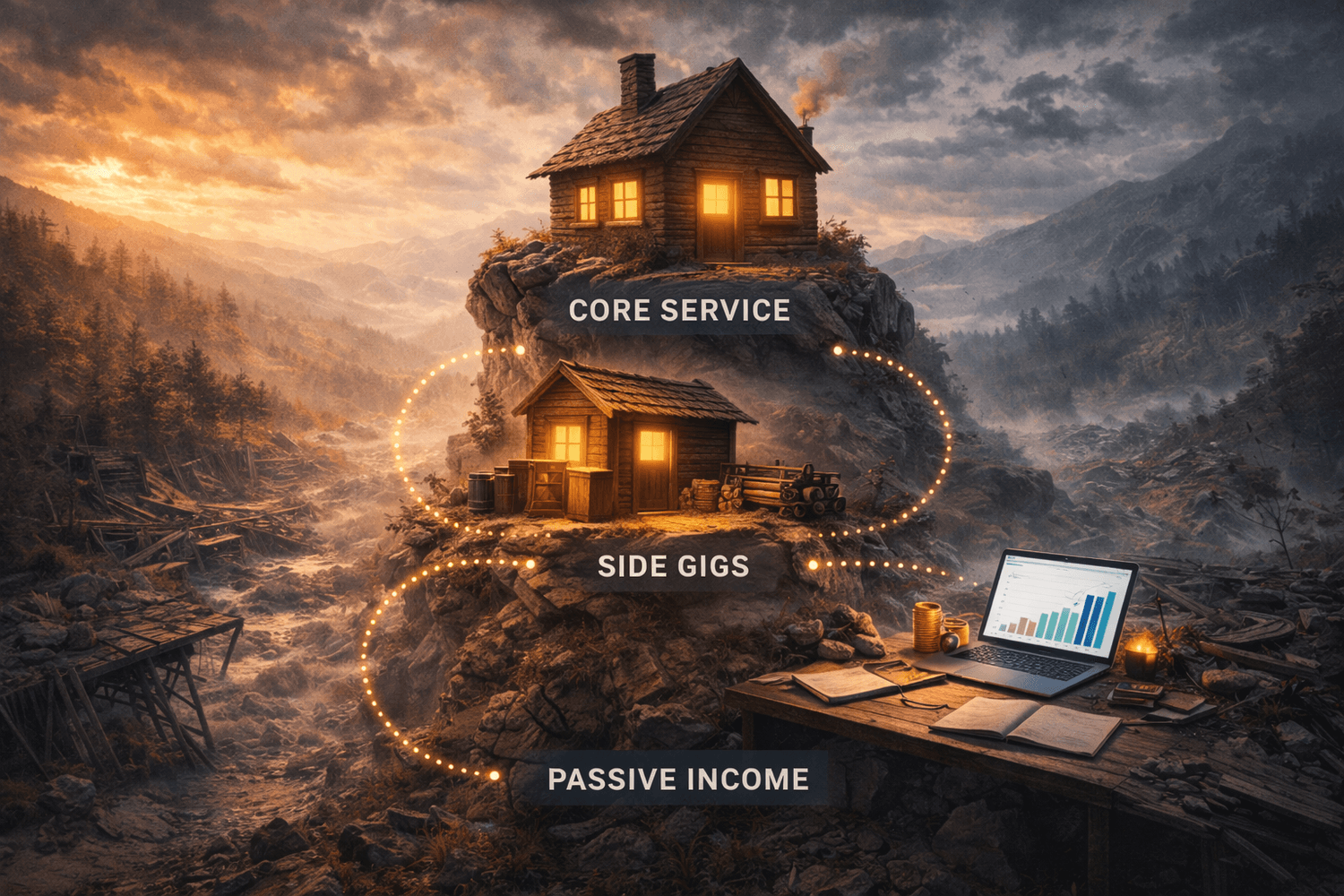
A layered income structure reduces fragility because it mirrors how survival systems actually work. Stability comes from distribution, not dependence.
A core service provides predictable cash flow and anchors operations
Short engagements add adaptability during demand swings
Asset driven income builds long term momentum without constant exchange of time
Diversification is not about chasing more. It is about staying intact when conditions shift. Survival thinking values redundancy because redundancy preserves choice, flexibility and control under pressure.
Cash Flow Controls Beats Motivation
Survival collapses when timing fails. Freelancers often earn enough on paper yet struggle because payments arrive late or billing cycles remain uneven. Cash flow discipline matters more than total revenue.
Control comes from simple rules:
Invoice immediately
Define payment terms clearly
Request partial advance fees
Keep fixed expenses restrained
These habits prevent panic. Negotiation strength improves. Survival thinking prioritizes control over excitement.

Emergency Funds Create Control
Freelancers do not receive employer benefits. Delayed payments, medical costs and equipment issues can appear without warning. An emergency fund absorbs these shocks and keeps decisions steady. Financial research also confirms that emergency savings improve resilience and reduce forced decisions during crisis periods (ResearchGate, May 1, 2025, A Study of Role of an Emergency Fund in Personal Financial Planning).
Early settlements survived by storing supplies before hardship arrived. Freelancers face a modern version of the same risk. Emergency reserves create clarity during pressure. Negotiations stay calm. Reputation remains protected. Survival thinking values preparation because reaction often comes too late.

Community Keep Freelancers Alive
No group survives alone. Cooperation shaped early endurance. Freelancers often confuse independence with isolation. That belief increases risk.
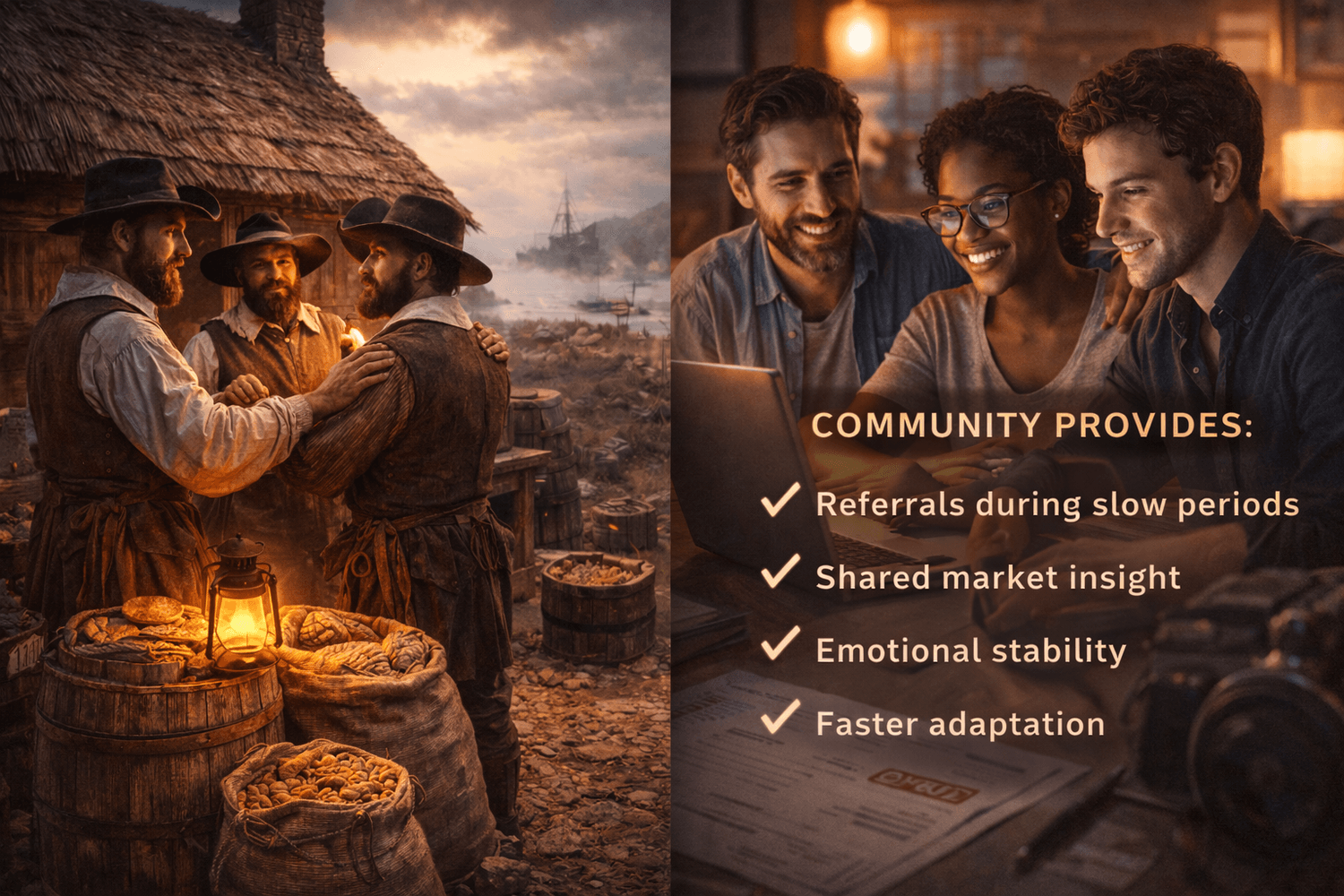
Community provides:
Referrals during slow periods
Shared market insight
Emotional stability
Faster adaptation
Networks function as informal safety systems. Survival thinking treats relationships as assets rather than optional extras.
Long Term Planning Wins
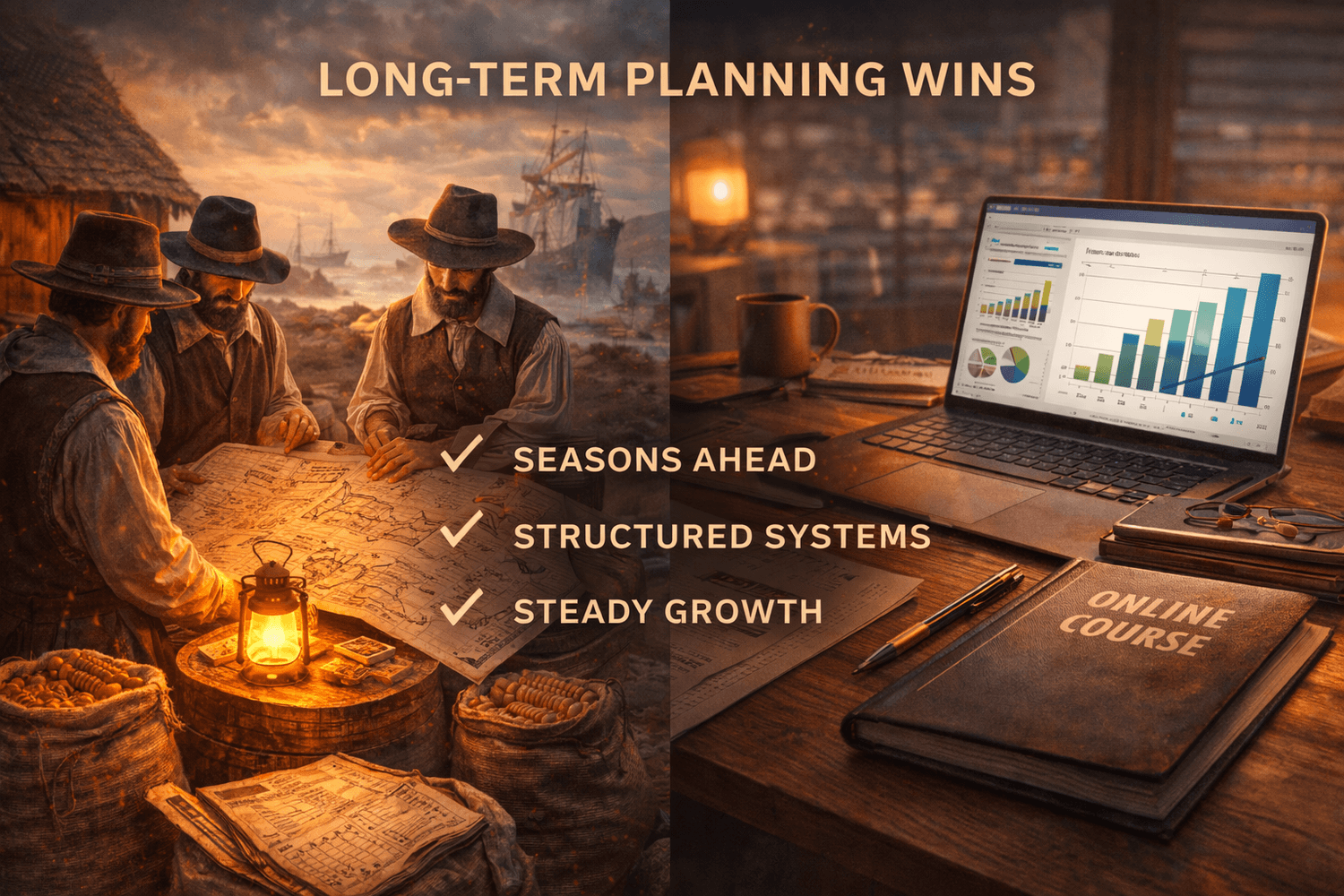
Survival favors patience. Early settlers planned seasons ahead because short wins could not protect them through long winters. Freelancers face a similar reality. Brief income spikes feel rewarding but fade fast without structure. Survival thinking pushes focus beyond the next payment toward systems that hold through slow cycles.
Money Hacker explains how skills become durable income only when they are shaped into structured offerings rather than one off effort. Courses, frameworks and repeatable knowledge turn time bound work into assets that grow steadily over time (The Money Hacker, December 19, 2025, Courses Turn Skills Into Online Income). This shift marks the difference between chasing tasks and building a career that compounds.
The pressure to react quickly often comes from the attention economy itself. Money Hacker shows how constant demand for visibility pushes creators into urgency loops that drain focus and stability (The Money Hacker, December 15, 2025, The Attention Economy Pushes Creators). Long term planning resists this trap. Growth becomes deliberate. Stability becomes achievable. Survival thinking replaces noise with direction.
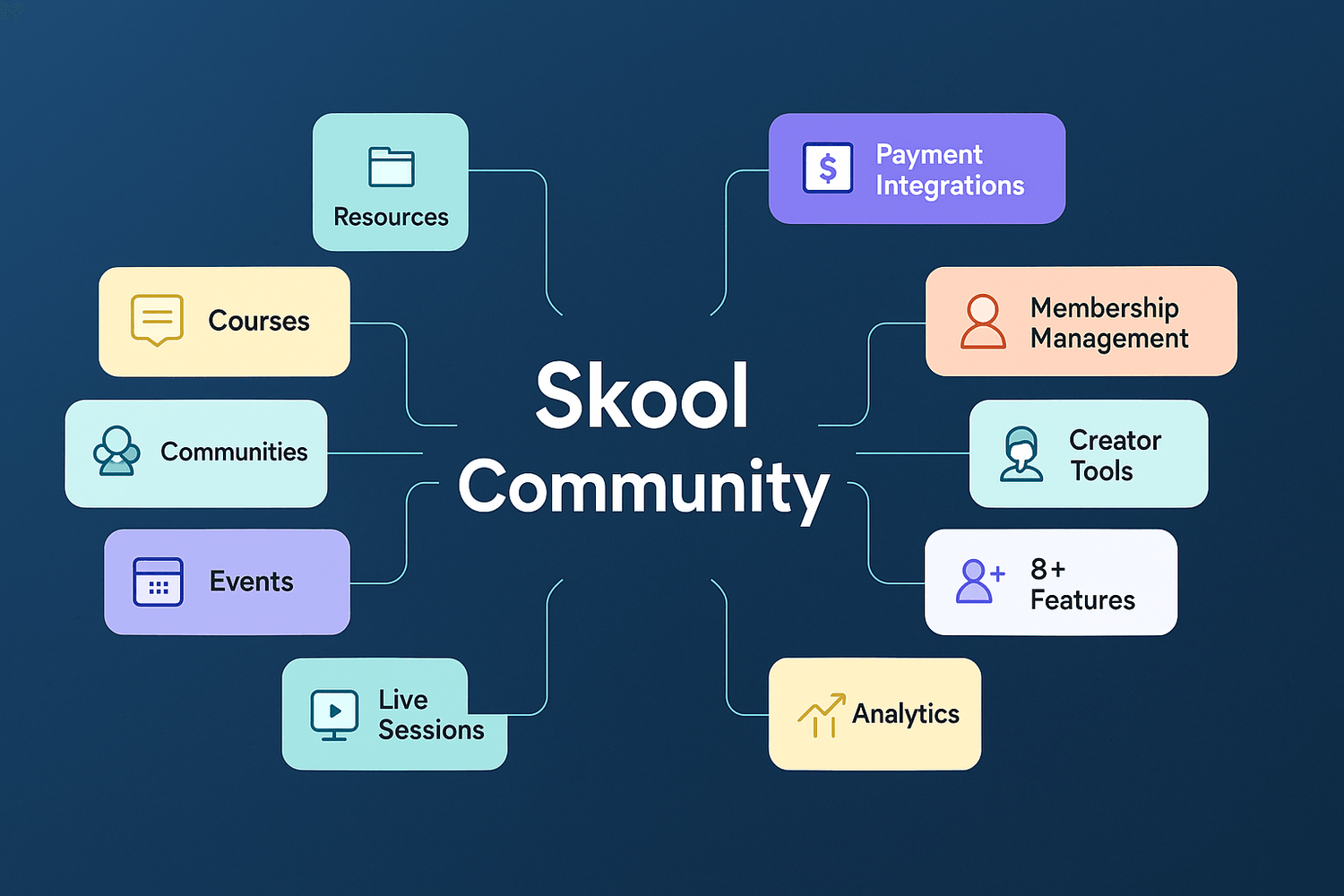
For long term growth and sustainability, you may join Skool community. This can be a perfect choice for you. $100K Money Hackers has been created for your benefit so that you get all sorts of support to make your freelancer career sustainable and successful. It ensures multiple businesses in just 7 days through expert network. Not money consuming. You can just try for it.
Frequently Asked Questions (FAQ)
Platform rules shift fast. Client priorities change without notice. Short contracts create gaps. Stability depends on systems, not effort alone.
It means planning before pressure hits. Buffers, structure and flexibility come first. Hope is replaced by design.
One main service builds consistency. Small side offers add balance. Assets grow long-term security.
Late payments create stress. Clear terms protect momentum. Timing keeps control alive.
Three to six months works well. It absorbs shocks. Decisions stay calm.
Networks bring referrals. Shared insight speeds adaptation. Support lowers isolation risk.
Conclusion
Forefathers’ Day is not nostalgia. It explains how survival actually functions. Endurance grows from preparation, role flexibility and strong support systems rather than speed or hope. Freelancers operate inside a modern frontier shaped by platforms, markets and shifting demand instead of land or weather. The core lesson remains unchanged. Stability emerges through deliberate design, not chance.


The Money Hacker